

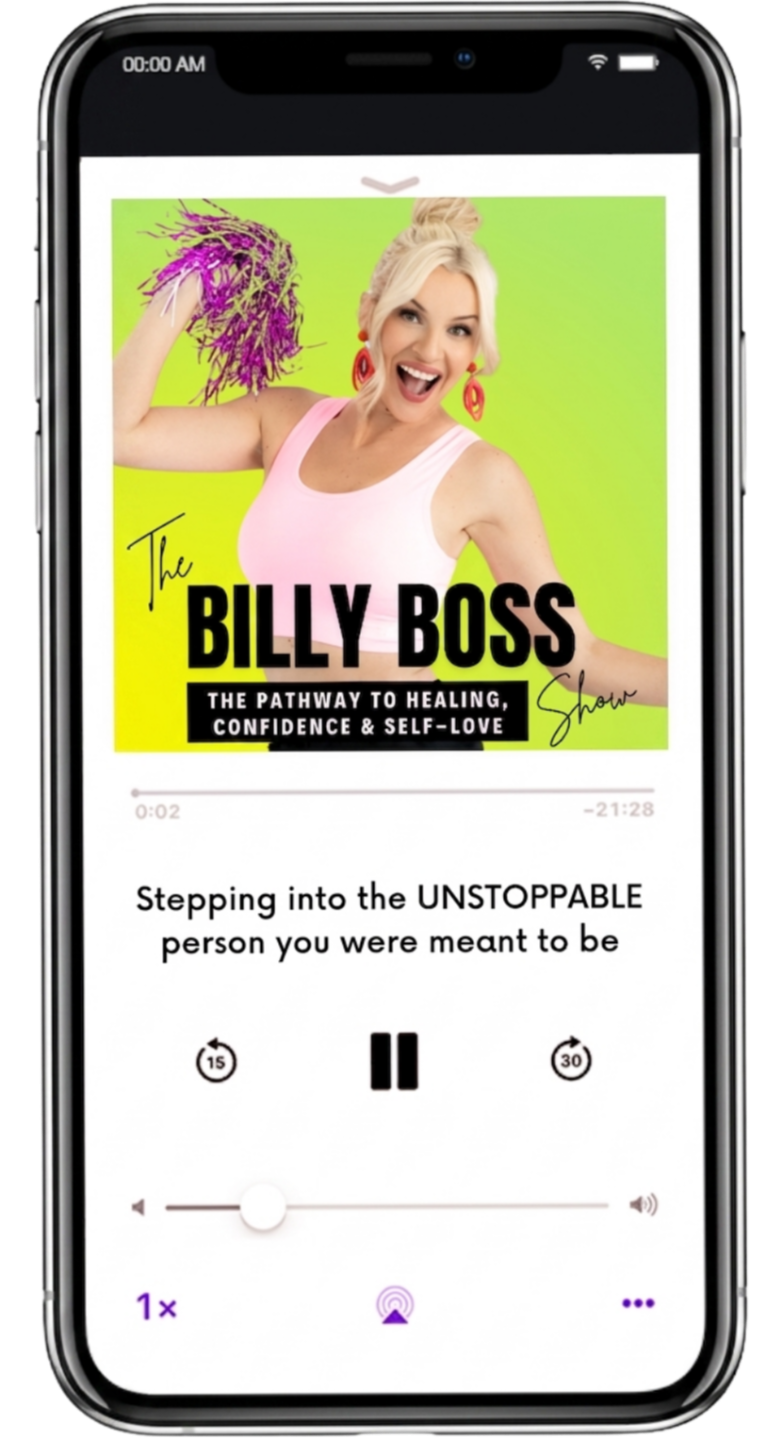
5 May 2026, by Billy Boss
Why Forgiving Yourself Is the Most Important Thing You’ll Ever Do
When has beating yourself up ever helped you heal?
Maybe it’s something you said in a moment you were overwhelmed. A relationship you stayed in for too long. A boundary you didn’t set. A choice you made when you didn’t yet know how to choose yourself. Even if years have passed, it can still feel like your past mistakes get the final say in how you see yourself.
So many women are living with an internal punishment loop. You try to move forward, but your mind drags you back. You build a good life, but it doesn’t feel like you’re allowed to fully enjoy it. You grow, but shame keeps whispering, “Not you. Not after what you did.”
In Episode 90 of The Billy Boss Show, we unpack what it really takes to release guilt and shame without excusing the past. This is a grounded, practical conversation about self-forgiveness, self-worth and confidence, and the kind of mindset transformation that helps you stop living as if you need to suffer in order to be good.
Why self-forgiveness is the foundation of emotional healing and personal growth
Many women have been taught, directly or indirectly, that self-criticism equals growth. That if you stay hard on yourself, you’ll stay accountable. That if you keep shame close, you’ll never repeat the mistake.
But self-hatred does not create change. It creates fear, tension, and a version of you who is constantly bracing for the next moment you “get it wrong”. It chips away at self-confidence because it teaches your nervous system that you are not safe with you.
Self-forgiveness is not about becoming passive or careless. It’s about choosing a new foundation: honesty, responsibility, compassion, and self-respect. It’s the shift from “I deserve to suffer” to “I deserve to learn”. And when you make that shift, you create the conditions for real emotional healing, because you’re no longer trying to heal while actively attacking yourself.
The difference between guilt and shame (and why it changes everything)
One of the most important distinctions in self-forgiveness is understanding what you’re actually carrying. A lot of women don’t realise they’re carrying two different experiences in the same emotional basket.
Guilt is behavioural.
It says, “I did something wrong.” It can sting, but it can also be useful because it points you back to your values. It often leads to repair, reflection, and growth.
Shame is identity-based.
It says, “I am wrong.” It doesn’t simply highlight behaviour. It defines your character. It turns one season, one mistake, one survival choice, into a permanent label: weak, unlovable, broken, not good enough.
That’s why shame keeps you stuck. If you believe you are bad, what’s the point of trying to change? Shame doesn’t motivate you, it reduces you. It erodes self-worth, makes you hide parts of yourself, and keeps your confidence conditional, only available when you’re doing everything “right”.
Separating guilt from shame becomes a turning point because it lets you take responsibility without turning your past into your identity. You can name what happened honestly while still holding onto a deeper truth: you are more than the thing you regret.
Self-forgiveness without excuses: accountability that rebuilds your self-worth and confidence
Sometimes self-forgiveness feels hard because it’s been misunderstood. Many people think forgiving themselves means minimising what happened, pretending it didn’t matter, or letting themselves off the hook.
But self-forgiveness is not denial. It doesn’t erase impact. It doesn’t rewrite history. It simply refuses to let the past become a life sentence.
Accountability can be clean and empowering. It can mean owning your part without carrying other people’s wrongdoing. It can mean being honest about what you did or didn’t do, without collapsing into self-attack. It can also mean recognising that responsibility and compassion can exist in the same breath.
When accountability is paired with compassion, it strengthens your inner foundation instead of destroying it. That’s how confidence grows in real life, not through never making mistakes, but through meeting your mistakes with integrity and choosing to learn rather than punish.
How to forgive yourself: four steps that turn shame into growth
Self-forgiveness becomes possible when it stops being a vague idea and becomes a process you can walk through, especially when shame feels heavy.
This simple four-step process gives you structure in the middle of emotional chaos. It helps you move from secrecy to honesty, from self-blame to responsibility, and from being trapped in the past to building a future you feel available for. This matters because many women do not stay stuck due to a lack of desire to change. They stay stuck because they do not know how to release what they are carrying in a way that feels safe, clear, and real.
▪️ Step 1: Name it. Bring the thing you’ve been avoiding into the light. Shame thrives in secrecy, so naming what happened, out loud or on paper, is the first shift from spiralling to clarity.
▪️ Step 2: Take responsibility. Own your part without taking on what was never yours. This is about honest accountability, not self-attack, and not carrying other people’s wrongdoing.
▪️ Step 3: Extract the lesson. Turn pain into wisdom. Instead of replaying regret, you begin asking what this experience taught you, and what you would choose differently with the awareness you have now.
▪️ Step 4: Create closure. Seal the forgiveness with intention. Closure can be a letter, a ritual, a mirror affirmation, or a moment that helps your mind and body register: “This is complete. I can move forward.”
When shame has had years to build momentum, you often need more than positive self-talk. You need a grounded pathway that brings you back to self-respect, self-trust, and choice.
Reframing your story: how self-love and self-confidence are rebuilt in real life
One of the most painful things about shame is that it doesn’t just make you remember the past, it makes you interpret the past in the harshest possible way.
It’s rarely just “That happened.”
It becomes “That happened, and it proves I’m stupid.”
It’s rarely just “I stayed.”
It becomes “I stayed, and that proves I’m weak.”
It’s rarely just “I had a hard moment.”
It becomes “I had a hard moment, and that proves I’m a terrible person.”
Reframing isn’t pretending the past didn’t happen. It’s choosing to stop using the past as evidence that you are unworthy. Nothing has meaning until we give it meaning, and when you change the meaning you give something, you change the story you live inside.
A reframe brings you back to a more accurate perspective: you were doing your best with the awareness, tools, and support you had at the time. Now you know more. Now you can choose differently. That is growth. That is healing. That is self-respect in motion.
If you’ve been punishing yourself, let this be the day you come back to you
If you’ve been carrying shame like a badge of honour, as if staying disappointed in yourself is proof you care, pause for a moment and let this land gently: you don’t need to keep paying for the past with your identity.
Unforgiveness doesn’t change what happened. It only keeps you living as if it’s still happening. It drains your energy, clouds your clarity, and quietly blocks you from showing up fully, because part of you is still stuck in the moment you regret. It can make you feel like you have to earn joy, earn love, earn peace, earn your own approval, and that is a heavy way to live.
Self-forgiveness creates space. Space to breathe again. Space to take responsibility without drowning in it. Space to stop repeating the punishment story and start building a different relationship with yourself, one rooted in truth, compassion, and growth. It is choosing freedom over guilt, growth over shame, and self-respect over self-abandonment.
If there’s something you’ve been holding over your own head, something you replay when life gets quiet, something you’ve used as a reason to stay small, consider this your invitation to let go.
You are allowed to be accountable and still be kind to yourself. You are allowed to learn and still be worthy. You are allowed to move forward, even if you can’t change what happened. And you are allowed to start today, because you have carried this long enough, and you deserve to feel safe inside yourself again.
____
Ready for deeper support?
If you are ready to heal the parts of you that still carry shame, to finally forgive yourself and rise, I want to invite you into Release & Rise. This is a structured support for women ready to heal deeply, live freely, and live fully. Join the priority list here:
Join the Release & Rise Priority List
And if this episode stirred something in you and you have a question, or there’s a topic you’d love me to cover on the show, Ask Billy Anything is open for you. Send through your question, and I promise I’ll get back to you. Submit it here:
Ask Billy Anything
Follow me here:
Instagram
Facebook
Website
Sign up for my weekly dose of love newsletter for YOU at: billyboss.com
Hello and welcome to today's episode of the Billy Boss Show, your pathway to healing, self-love and confidence. I'm your host, Billy Boss, and if you haven't done so already, hit that subscribe button so you never miss another episode. New episodes come out every Tuesday to help you learn, grow, and transform your life. And I doubt sometimes you can hear a tiny bit of my humor throughout the episodes as well. So just to reassure you that transformation doesn't have to be so serious, but can be still very successful through humor.
So if you are looking to improve your life, if you're searching for the ways to heal deeply and rise powerfully, remember hit that subscribe button and don't miss a beat. Today I'm going to share with you why forgiving yourself is the most important thing that you'll ever do for yourself, not for anybody else? So today I want to ask you something that might stop you in your tracks. When has self-hatred helped you heal? Honestly, think about it. When has self-hatred helped you heal? Or when has beating yourself up helped you become a better person? Talking down to yourself, being so negative about yourself, dragging yourself down.
When did it help you to become a better person? I'll wait. And I can tell you, I can wait here hours and days. But the truth is it never has and it never will. You don't heal through shame, you don't heal through beating yourself up, but you heal through honesty and compassion. And yet, so many of you are carrying shame around. Some of you you're carrying that shame as a badge of honor, and it keeps you small, and it keeps you tied and it keeps you stuck. But here's what I need you to know. You can forgive yourself, and when you do, it is so liberating. It gives you such a freedom. And forgiving yourself is the most important thing that you will ever do for yourself. Because being stuck isn't just about your circumstances.
It's about your mind being stuck with some hurt. Some story you keep telling yourself about who you are because of what you did. Not forgiving yourself. This is where rage is accumulated. Your anger, bitterness. And it's heartbreaking to see so many people living their entire lives stuck in that place. So today we are talking about forgiveness, real, honest, life-changing self-forgiveness. So let's start with what it actually means. So what is forgiveness?
Forgiving yourself isn't about pretending that things didn't happen. And it's not about denying the past or making excuses for your behaviour. None of that. So it's not pretending, it's not denying that things did not happen. Forgiving yourself is about taking accountability, it's about learning the lesson, it's about releasing the past so you can then grow from it and move in a way that I would usually refer to peace within yourself. So it's about saying, I did something that I'm not proud of, I accept that.
But before we go there, we need to understand what's really keeping us stuck in the first place. So at the core of not forgiving yourself, we are living with guilt and shame. And here's where it gets very important. Guilt and shame are not the same thing. Guilt says, I did something wrong. Shame says, I am bad, I'm bad person, I'm bad mum, I am bad girlfriend, sister. So guilt is behaviour, or guilt is about behaviour, but shame is about identity. And this is where so many people keep themselves stuck at the guilt and shame level. So guilt says I stayed too long in that toxic relationship. So that's guilt. Guilt also says I said something hurtful to my child when I was overwhelmed. Guilt also says I didn't set boundaries where I should have.
I made a decision that hurt someone I love. And guilt certainly says I ignored the red flags because I was scared of being alone. So these are all behaviour driven. Where shame, on the other hand, says, I'm a such a bad mum. I'm such a weak person for staying, I'm pathetic, I'm unlovable. No wonder people leave me. Shame also says that I'm terrible friend, and it also says that I always let people down. I am broken. I will never change. So can you see the difference between guilt and shame? Guilt is saying I made a mistake, it is specific, it's about what you did. Shame on the other hand says I am a mistake. It's about who I am, who you are. And shame? Shame keeps you trapped because if you believe you are bad, then what's the point of trying to change? So this is why today's episode it's very important that we can dive into learning how to forgive ourselves so we never feel stuck.
Forgiving yourself means taking accountability, owning what you did, not making excuses, not blaming others, not pretending it didn't happen. It means learning the lesson. It means releasing the past and choosing to grow from it. It means accepting that you did your best at the time with awareness, the tools and support that you had. It certainly doesn't mean what you did was okay. It means you are choosing not to let it define you forever. So this is what forgiveness really means. And let's now dive into how you can forgive yourself. So, how do you actually do this? How do you forgive yourself when the shame feels so heavy?
Let me walk you through this. Step one, name it, call it out loud, write in your journal. This step is about bringing what you've been avoiding into the light. You're sharing it. Shame thrives in secrecy. So if we are wanting to let go of the shame and heal this wound and forgive ourselves, there is no more secrecy. Shame grows in secrecy and it grows in silence. So there is no more silence. We need to say it out loud. The moment you name it, the moment you acknowledge it, you take away some of its power. So let's practice this. Write it down. What really happened? I stayed too long in this relationship. I really messed up with my kid that day. I ignored my intuition and it cost me. And while you're writing it, whatever that is for you, when you're saying it out loud, when you are writing it, don't judge yourself for it. Also do not explain to yourself why. Just name it. Just write as it happened.
Because you can't heal what you won't acknowledge. So the step one is all about acknowledging. I stay too long in that relationship. And the act of naming it is the first step toward setting yourself free. And step number two, this is where we take responsibility. This is where it gets very important. Some situations need your part of responsibility, but you don't need to take on other people's wrongdoing. Only take yours. This is your responsibility. So many of us carry guilt and shame for the things that weren't ever our fault.
But we take on responsibility for other people's choices, other people's pain, other people's behaviour. That is not for you to carry. Carry your own burden. What is your responsibility? What is in your control? Remember other people's things. It's not yours to carry. So I want you to ask yourself, what is actually my part in this? What did I do or not do? What was my role in this situation? And then on that part, not all of it, not they part, just your part. What is your part in this? And I'll give you an example. Maybe you stayed too long in the toxic relationship, and maybe I'm repeating this because this actually happened to me. I stayed too long in in one of my relationships, or maybe quite a few relationships, too long. So your part might be that you ignored the red flags. Certainly I did. You didn't set the boundaries.
Certainly I didn't set any boundaries. You prioritised their feelings over your own well-being. Hello, that's me. But their part, their manipulation, their lies, their abuse, that's not yours to carry. On your part, release the rest. If you're craving even more inspiration and real talk to fuel your confidence and success, I've got something special for you. Make sure you join my weekly dose of love. It's feel good email that lands in your inbox every Tuesday, packed with motivation, mindset tips, and tools to help you thrive in life and business. You can sign up at Billyboss.com or simply click the link in the show notes wherever you're listening to this episode. Go on, give yourself that little boost of love each week because you deserve it.
Now we get to step three. This is where the transformation happens. And this is the part where we need to gain the lesson from it. This is where you shift from shame to wisdom. Because if you just name it and then take responsibility, but you don't learn from it, guess what? You're likely to repeat that pattern again and again and again. So journalling is a powerful way to do this. Sit down with yourself, only with yourself, and ask your amazing self. If this situation happened today, how would I respond differently? What do I know now that I didn't know then? What was I trying to protect back then? And what was I afraid of?
And another question that you can ask yourself is how can I do it differently next time? So these questions will help you extract the wisdom from the pain. They will help you to see that you weren't bad or broken. In fact, you were just doing your best with the awareness, with the tools, and the support you had at the time. And now, guess what? You know more, you learn more. Now you know better. So this is growth, this is healing. So it's very important to extract the lesson and take that lesson with you. This is where we will less likely repeat that pattern moving forward.
And we come to step number four. This is where we do create the closure with ourselves. And this is the step that seals the forgiveness. Don't you love when there is time to seal something? And this is where you make it real. Closure can look differently for everyone. It might be writing a letter to your younger self, which I have done so many times, thanking my younger self for surviving, for doing her best, for keeping you safe. So you might actually choose to write your younger self a letter. It may be a visualisation where you see yourself releasing the shame, releasing and letting go, watching it dissolve. I also have done this.
What I also have done, I made a very significant point that writing some certain letters, I will burn them. And it just makes me like seeing that, like really living myself, living my soul and just dissolving it. It also may be standing in the front of the mirror, looking at yourself in the eyes and saying out loud, I forgive myself for what I did. I release the shame. I choose to move forward. It's very important to create some type of ritual. And with that you're also creating a momentum.
Make it intentional and then reframe the story that you have been telling yourself. Instead of I'm so stupid for saying so long, I'm inviting you to try I was doing my best to survive. I didn't have the tools then that I have now, and I forgive myself for that. Maybe instead of saying I'm terrible mum, you can try I had a hard moment. I'm human, I'm learning, and I'm doing better every day. The reframe doesn't erase what happened, but certainly it changes the meaning that you do give. And that changes everything because nothing has the meaning until we give the meaning to it. So give the great meanings and this is where reframing is very important. So let me share a tiny bit of story of myself. So for many, many years I have beaten myself for staying at home despite that I was abused as a child. So from the age of six to almost seventeen, I stayed home and I carried so much shame about it.
So I would ask myself over and over again, why didn't I try harder? Why didn't I fight back more? Why didn't I run away sooner? Why at 17 and a half I ran away? Well the truth is I did try. I did try to run away. I did everything a child could do in that situation. I also remembered running away with somebody who almost killed me because I thought that was my better option, just not to be at home. So I did really try my best. But for many years I told myself, maybe I needed to try harder. And that shame, it kept me stuck. It kept me very, very small and kept me believing that I was weak person. And honestly, until one day I did realise something that's changed everything. I was a child. I really didn't have so much power. I didn't have many resources, the awareness that an adult has. But in fact, I was doing my best just to survive. I did try to run away, but somehow I was pulled back home.
And the moment I forgave myself, the moment I said you, Billy, did nothing wrong, you were just trying to stay safe, that's when I started to heal. That's when I stopped being stuck in the past and started building my future. So it is possible, it is possible to forgive yourself. It is possible to get rid of that shame and guilt. And here's why forgiving yourself matters so much to you. Because unforgiveness keeps you trapped in the past. It keeps you living in a story that's already over. The past is gone, you are here now. You can't change what happened in the past. Memory will stay forever, but you can change the meaning. And we call that reframing. Unforgiving yourself, it will drain your energy. It clouds your clarity, it stops you from showing up fully in your life. But when you forgive yourself, you free yourself, you stop carrying the weight of who you were, and you start becoming who you are meant to be.
You stop pushing yourself for being human and you start honouring yourself for surviving. When you forgive yourself, you stop letting shame write your story and you start writing a new one. One that it's rooted in the truth, rooted in compassion and in growth. Forgiving yourself doesn't mean what you did was okay. But it means you are choosing to release the grip it has on your life. And it means choosing freedom over guilt, it means choosing growth over shame. It means you are choosing yourself, and this is where we want to get to, to choose yourself. Stop abandoning yourself. And here are my final thoughts for today's episode. I want to ask you again. When has self hatred helped you heal? When has beating yourself up made you better? It hasn't. And it never will. It won't.
But forgiveness, forgiveness changes everything. So if there is something you've been holding on to, something that you've been pushing yourself for, something that you can't let go of, well, today is the day. Forgive yourself. You deserve to be free. Now, if this episode stirred something in you, if you have any questions for me, or if there is something that you would like me to share about on the show, head to show notes and click on Ask Billy anything.
Leave me a message, and I promise I will get back to you. And if you're ready to go deeper to heal the parts of you that still carry shame, to finally forgive yourself and rise, I want to invite you to the Release and Rise experience. This is a place to heal deeply, live freely, and live fully. All details will be shared with you first when you get on our priority list. Head to the show notes, click the link, and secure your spot. Your rising starts now. Your support helps us reach more incredible people just like you.
I Am the Black Sheep of My Family, And It Saved My Life
Coming Soon